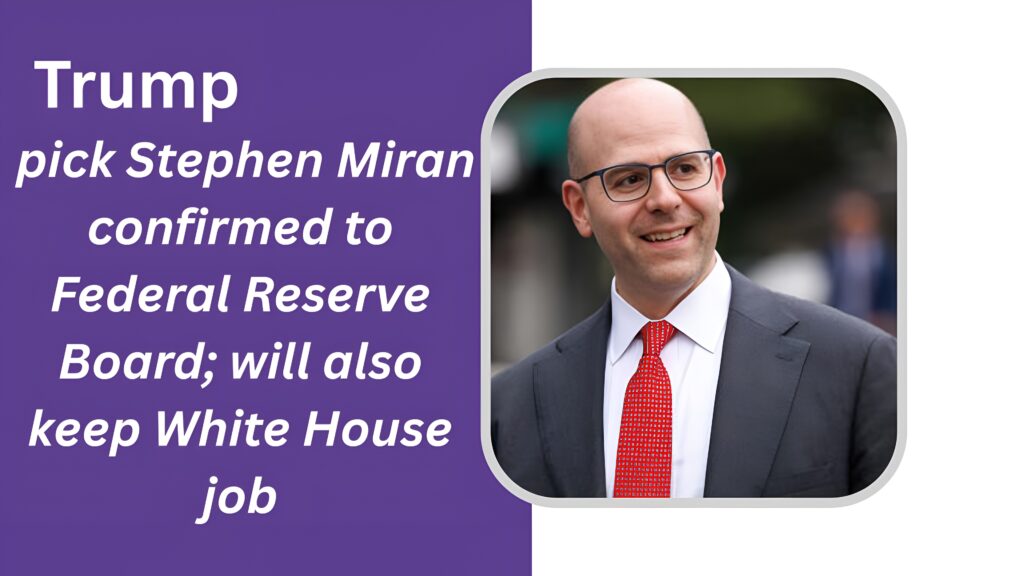
The Senate on Monday narrowly confirmed President Donald Trump’s nominee Stephen Miran to serve on the Federal Reserve Board of Governors, approving him in a 48–47 vote just one day before the central bank begins its closely watched meeting on interest rates. The vote was almost entirely along party lines, with Republican Sen. Lisa Murkowski of Alaska siding with Democrats in opposition.
Miran’s confirmation means he will immediately join the Federal Open Market Committee meeting set for Tuesday in Washington, D.C., where members are expected to cut rates for the first time since December 2024. While Miran is not likely to cast a decisive vote this week, he could become a dissenting voice if the committee opts for only a quarter-point reduction rather than the half-point cut favored by both Trump and some conservative economists.
The nomination has been controversial, largely because Miran also serves as chair of the White House Council of Economic Advisors. He has pledged to take an unpaid leave of absence from that role but has not committed to resigning, heightening fears among Democrats and policy experts that the Fed’s independence is at risk.Sen. Elizabeth Warren cautioned that even “one day” of Stephen Miran serving both as Trump’s chief economist and as an “independent” Fed governor would be “one day too many.”
Miran will serve out the remainder of the term vacated by former Governor Adriana Kugler, which expires in January 2026. His confirmation comes as Trump continues to escalate pressure on the Fed, urging Chair Jerome Powell to slash borrowing costs more aggressively, while simultaneously attempting to remove Fed Governor Lisa Cook — the first Black woman to serve on the board — over disputed allegations of mortgage fraud. A federal appeals court on Monday blocked Trump’s effort to oust Cook, ensuring she will remain at the table for this week’s rate decision.
The fast-tracked confirmation underscores both the political stakes of Trump’s push for lower interest rates and the broader debate over the Fed’s independence at a moment of heightened economic uncertainty.