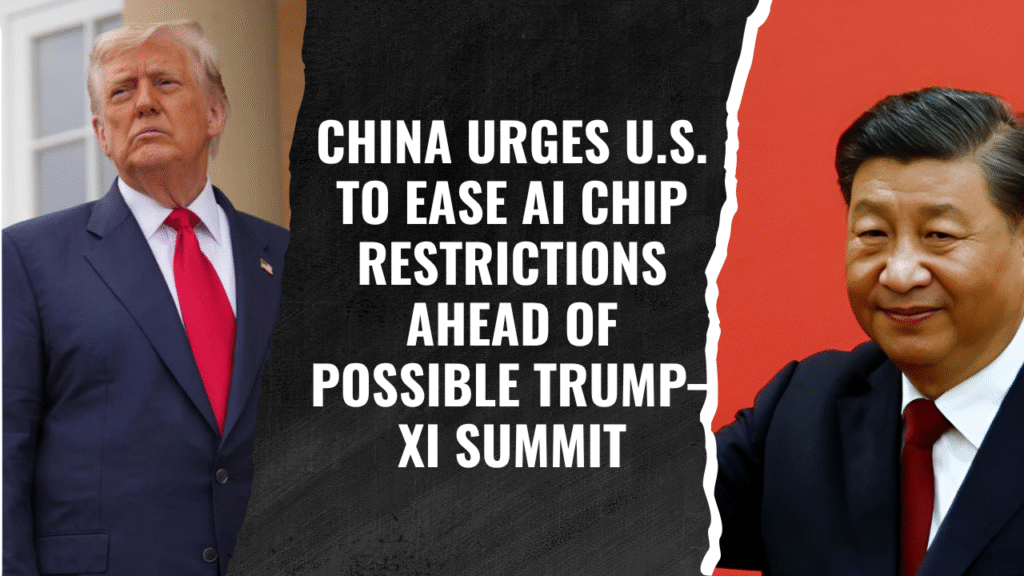
China is pressing the United States to relax export controls on high-bandwidth memory (HBM) chips, a critical component in advanced artificial intelligence systems, as both nations explore the possibility of a meeting between President Donald Trump and President Xi Jinping.
HBM chips, used alongside AI processors, are essential for handling massive data volumes in AI training and inference. Beijing argues that current U.S. restrictions have severely hampered the ability of Chinese companies, including Huawei, to compete in global AI development.
The push for concessions comes as Washington and Beijing seek to stabilize a strained relationship, weighed down by trade tariffs, technology limits, and geopolitical disputes in the South China Sea and Taiwan Strait. Under current export rules, companies such as Samsung, SK Hynix, and Micron—along with U.S. AI processor makers—are barred from selling high-performance HBM chips to Chinese firms without special licenses.
Granting China greater access could help narrow its technology gap with the U.S., though it would run counter to Washington’s goal of slowing China’s AI progress, particularly in areas with potential military use. While domestic chipmakers like ChangXin Memory Technologies and Yangtze Memory Technologies have advanced in memory production, they remain years behind top global competitors.
American semiconductor companies, including Nvidia and AMD, could see significant commercial benefits if the restrictions are eased, though national security concerns remain central to U.S. policy. Allied nations such as South Korea and Japan have also pushed for more flexibility, warning of economic losses and supply chain disruptions.
The U.S. has enforced strict semiconductor export rules since 2022, expanding them in 2023 and 2024 to cover high-performance HBM chips that exceed specific performance metrics. The aim is to curb China’s ability to build next-generation AI models.
While no summit date has been set, diplomatic activity has intensified. Officials are considering a potential meeting in Asia later this year, possibly alongside the Asia-Pacific Economic Cooperation (APEC) summit in South Korea from October 30 to November 1.
President Trump has suggested he would only meet Xi if a favorable trade agreement is secured, signaling caution about committing to a summit without concrete outcomes. Analysts warn that such talks could reshape global trade dynamics, influencing negotiations with the EU, Japan, and other partners.